Fraud Fighters
Fraud education is often generic and easy to overlook, especially for newcomers facing unfamiliar scams. Fraud Fighters turns it into an adaptive learning loop inside the banking experience.
What I led
Set the product direction, aligned a cross-functional team around a behavior-change opportunity, and translated a broad fraud problem into a focused learning loop.
Product question
How do we turn scam awareness into a habit people return to when they need it?
My workflow
01
Frame
Turned generic fraud education into practice for newcomers to Canada.
02
Research
Mapped scam-recognition gaps, newcomer context, and learning behaviors.
03
Design
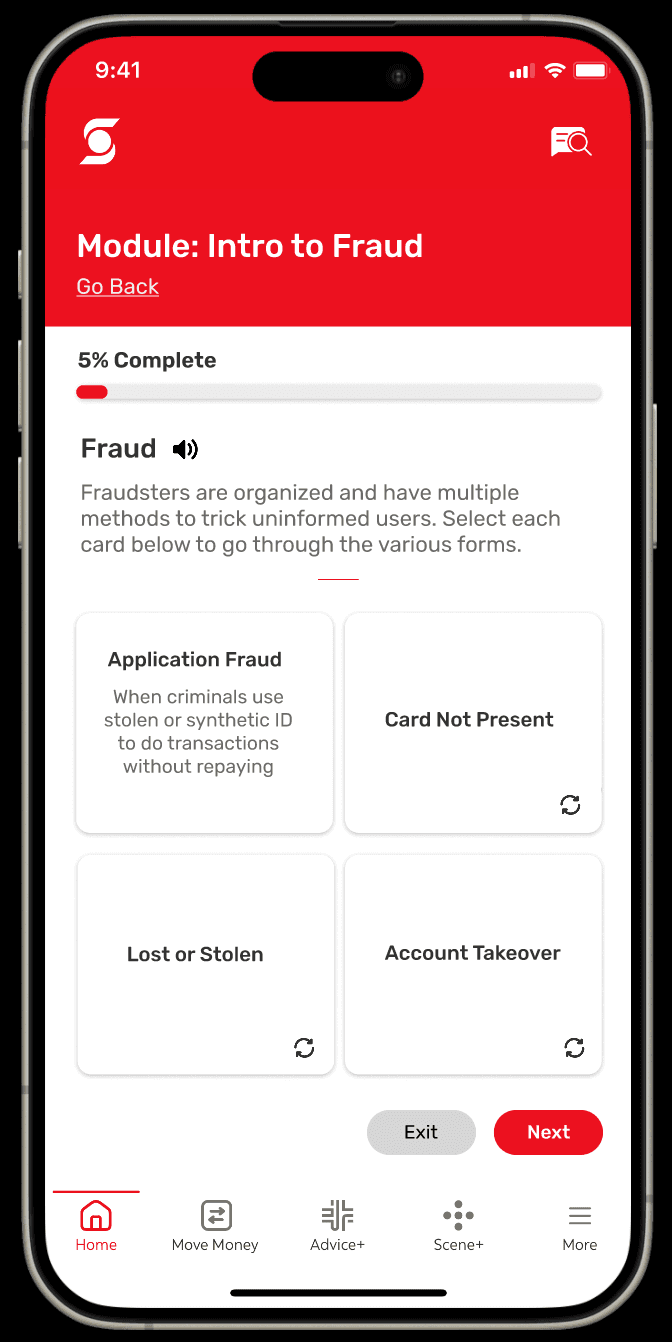
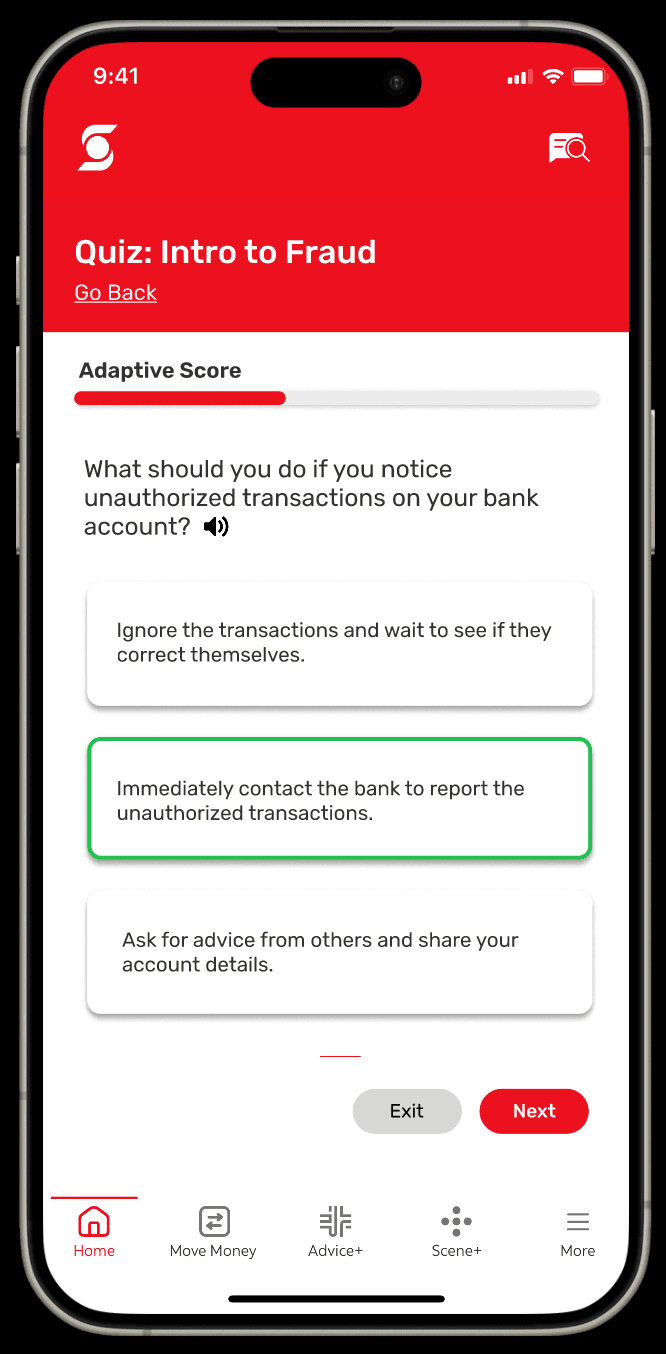
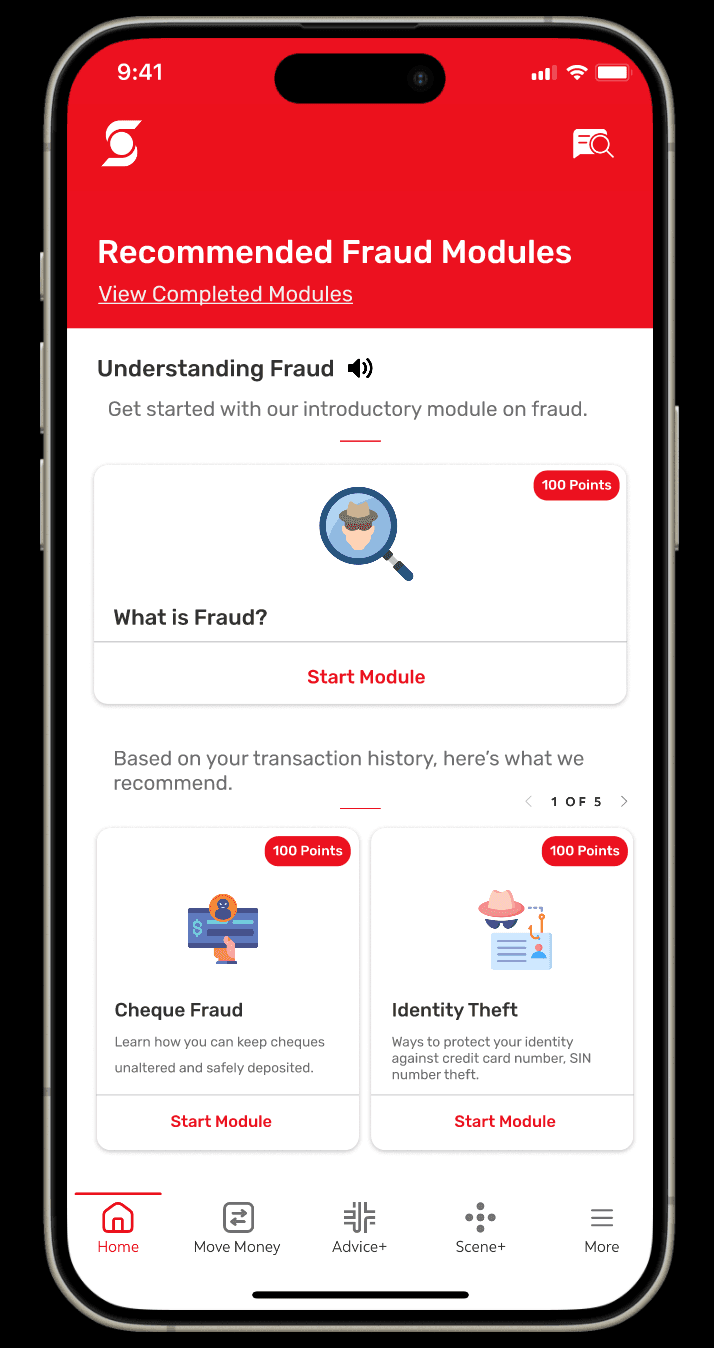
Designed adaptive modules, scenario quizzes, and recommendations around mastery.
04
Iterate
Balanced accessibility, Scene+ rewards, and the conceptual ML model with the core loop.
The problem
Knowing about scams is not the same as recognizing them. Generic warnings explain scams, but recognition requires practice. We shifted from "Here's a warning" to "Let's help you recognize it yourself."
Insight #1
Fraud education needs to be relevant to the person.
We prioritized newcomers to Canada, using user context, learning history, and performance to recommend relevant modules. The goal was to help users recognize the scams they are most likely to encounter.
Insight #2
Recognition is a skill, so practice matters.
We designed a loop: Learn -> Quiz -> Master -> Recommend. Users build recognition through short modules, then receive personalized next steps based on performance. Scene+ rewards support habit formation.
Solution
A fraud coach that learns with you.
Fraud Fighters lives inside the banking experience rather than sending users somewhere else to learn.
- Adaptive modules: content tailored to each user's learning needs.
- Interactive quizzes: realistic fraud-recognition practice.
- Progress and mastery: visible growth over time.
- Scene+ rewards: incentive to keep learning.
- Accessibility controls: text-to-speech and accessible defaults.
Design decisions
Personalization without overbuilding.
We used a Random Forest concept to weigh performance, completion, learning history, context, and user information, then tailor recommendations to likely vulnerabilities.
Teach in the context of real risk.
Instead of separating fraud education from banking, the experience sits directly inside Scotiabank's app context where users are already managing money.
Practice recognition, not recall.
Quizzes emphasize realistic decision scenarios rather than memorizing definitions, helping users build instinct for suspicious behavior.
User testing
The one-day hackathon left limited room for iteration, so this was a first-pass prototype.
The key question was whether adaptive recommendations improved learning more than fixed or randomized sequencing.
Outcome
1st place winner
The concept showed how fraud education could become a repeat habit instead of a one-time warning.
The next step would be testing whether adaptive recommendations improve retention and recognition over simpler sequences.