Learn LLM
AI makes coursework easier to complete, but not necessarily to understand. Learn LLM explores a different model: AI that guides reasoning instead of replacing it.
What I led
Set the product direction, shaped the explain-don't-solve interaction model, and helped the team narrow scope around the learning loop that mattered most.
Product question
How do we create enough value for students and instructors that both sides keep using the product?
My workflow
01
Frame
Reframed AI from an answer generator into a coach for student reasoning.
02
Research
Spoke with students and a professor, then mapped student, instructor, and institution needs.
03
Design
Designed coach prompts, adaptive quizzes, course ingestion, and the instructor dashboard.
04
Test
Ran usability sessions over four months and narrowed the product to its core learning loop.
The Problem
Assignment performance wasn't matching understanding. Students could complete strong assignments with AI assistance, then struggle to demonstrate the same knowledge independently.
The problem wasn't using AI. AI was doing too much of the thinking.
Research
Was the problem actually real?
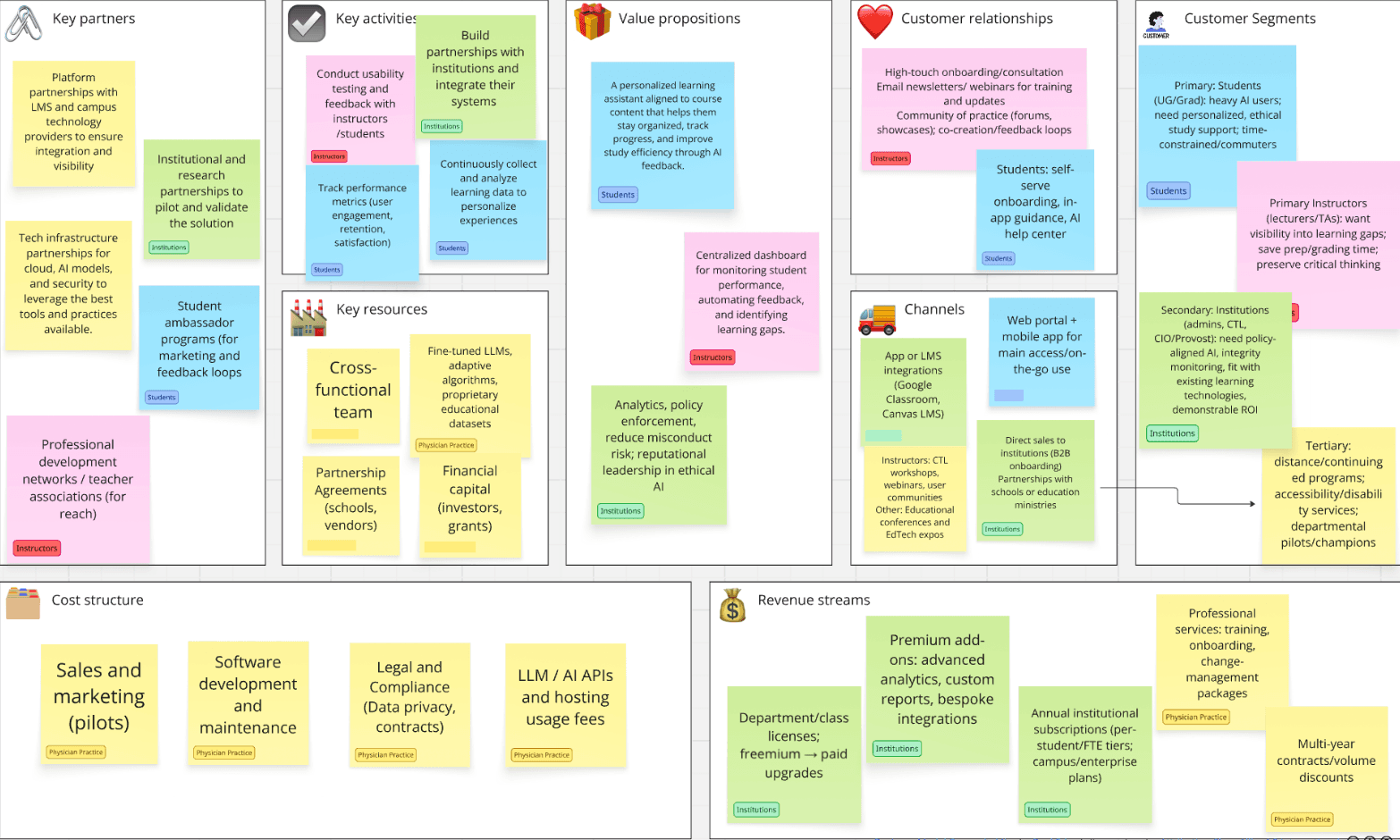
Through student conversations, our own experiences, and a Business Model Canvas, we mapped the needs of students, instructors, and institutions.
The recurring gap was: "I finished the assignment" ≠ "I understand the material." This became the foundation for Learn LLM.
Insight #1
Giving the answer is easy, but doesn't build understanding.
A traditional answer-bot would let students ask → receive → move on, reinforcing the behavior we wanted to change. So we flipped the interaction: what if AI asked students to explain their reasoning instead?
Insight #2
Useful friction keeps students thinking.
We developed an explain-don't-solve model where AI guides reasoning instead of giving answers. The goal wasn't to make assignments easier; it was to make thinking unavoidable.
Solution
A learning loop built around understanding.
Learn LLM became a two-sided platform connecting student learning with instructor insights.
- AI Coach — guides students through reasoning instead of solving.
- Adaptive Quizzes — reinforces concepts through retrieval and practice.
- Instructor Dashboard — supports course ingestion and learning insights.
- Course-Grounded Responses — uses course material to make coaching more relevant.
Design decision
From answer bot to learning partner.
We centered the experience around a guided reasoning loop: Student attempts → Coach probes → Student explains → Coach responds. This became the core interaction model across the product.
Design for both sides of learning.
Students get AI coaching, guided reasoning, and adaptive practice. Instructors get course-material ingestion and visibility into learning, without manually monitoring every interaction.
Design around the technical constraints.
Limited retrieval storage affected latency and how much course content could ground responses. Instead of treating this only as an engineering problem, we asked what information actually needs to be available for the coach to be useful.
User testing
Four months of periodic usability sessions with students and a professor challenged our assumptions and helped us simplify the flow, clarify the coach interaction, and narrow the scope around the core learning loop.
The goal shifted from building more features to making the core workflow work.
Outcome
We produced a live prototype with an AI coach, adaptive quiz loop, and instructor dashboard.
The next step was validating whether the explain-don't-solve model actually improves understanding and retention, not just engagement.